

AI-Powered Hospital Communication – Reach Patients Before Delays Do, with Vaarta
1.Introduction
Your doctor may be busy. Your first response should not be.
Patients have questions long before they ever speak to a doctor. They want to book an appointment, reschedule a visit, understand a test result, check on a referral, or simply know what happens next. In most hospitals today, those first conversations are still handled manually — and that is where the day starts falling behind.
What is an AI chatbot in healthcare?
An AI chatbot in healthcare is a digital first-response layer. It answers routine patient queries, supports appointment scheduling and rescheduling, and guides patients to the right next step — before a staff member needs to step in. It does not replace doctors or care teams. It fills the communication gap that exists before care begins.
That gap is growing. In 2024, 77% of patients were offered online access to their health records or portal, and 65% actively used it. Patients are not waiting for healthcare to go digital. They are already there. The question is whether your hospital’s communication has caught up.
2. How Scheduling Pressure and Slow Responses Are Costing Hospitals Every Day
The backlog does not arrive all at once. It builds quietly.
If you manage a hospital — whether a 50-bed facility in Jaipur or a 500-bed multi-specialty center in Pune — the operational pressure rarely comes from one catastrophic failure. It comes from ten small ones, running simultaneously, all day:
- Booking requests that arrive on WhatsApp, phone, and the website — in three different places
- Reschedule queries that need a staff member to check availability manually
- Missed callbacks from patients who did not get a timely response and booked elsewhere
- Billing and documentation questions that are repetitive but cannot be ignored
- Follow-up reminders that no one had time to send
The cumulative effect: replies slow down, schedules slip, and front-desk staff spend the majority of their day on repeat work instead of patient care.


3. The Market Has Already Moved. Most Hospital Workflows Have Not.
Three years ago, a hospital chatbot was a pilot project. Today, it is a line item in competitive hospital strategy. The global healthcare chatbot market is projected to exceed around ₹34,000 crore ($4.3 billion) by 2030 growing at a CAGR of 24% from (2025 -30)— not because of hype, but because the operational case is now impossible to ignore.
The shift is not just about AI technology. It is about patient behavior changing first. People now expect healthcare to feel easier to reach, easier to book, and easier to navigate. When a hospital’s communication does not meet that expectation, patients do not wait — they move to a provider who does.
$4.3B+ by 2030.
78% patient openness.
40%+ faster flow.
For hospital administrators and operations heads evaluating tools today, the question is no longer “should we adopt an AI chatbot?” It is “which one fits our workflows, our patients, and our communication channels?”


4. Meet Vaarta: The AI Chatbot Built for Hospital Communication
One platform. Every routine communication job — handled.
By the time a hospital administrator is evaluating solutions, the problem is no longer theoretical. The volume of patient queries is real. The pressure on the front desk is daily. And the cost — in missed appointments, slow replies, and staff burnout — is measurable.
This is where Vaarta Chatbot fits — not as an experiment, but as an operational layer that takes over the first tier of patient communication, so your team can focus on the second tier: actual care.
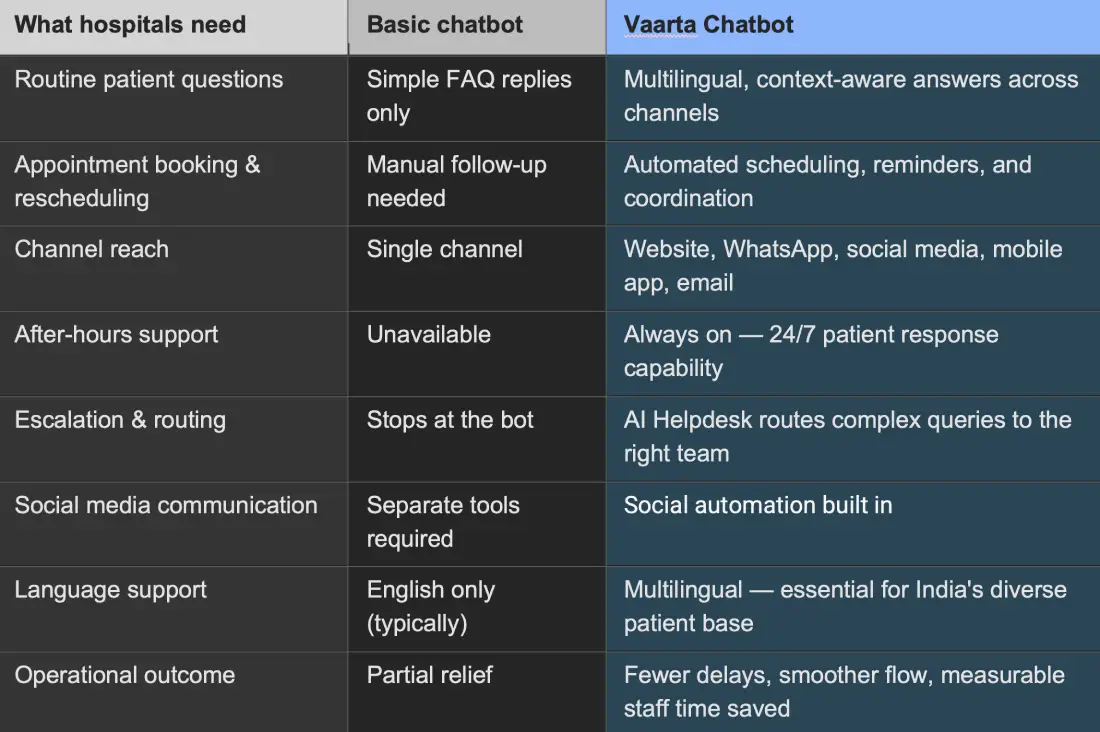
Vaarta helps hospitals manage routine patient communication faster, across the channels patients already use — website, WhatsApp, social media, mobile apps, and email. It also extends beyond the chatbot layer with AI Helpdesk for smarter issue routing and social media automation for managing DMs, comments, and campaign-level engagement — so communication does not stay scattered across five different tools.

Vaarta vs. a basic hospital chatbot — what actually changes
5. Real Healthcare Workflows Where Vaarta Reduces Daily Pressure
The best way to understand Vaarta’s value is not in features. It is in the specific moments during a hospital’s day where communication breaks down — and how Vaarta prevents that from happening.
1.Appointment booking and rescheduling
Booking requests, cancellations, and schedule changes keep coming through different channels. Vaarta helps you manage them faster — from confirmations to reschedules — without making every update depend on a manual callback.
2.Routine patient questions
Vaarta is positioned to handle routine patient queries and FAQ-style communication across channels, which helps reduce repeat first-response work.
3.Prescription reminders and post-visit follow-up
Patient care does not end at discharge. Missed medication reminders and absent follow-up communication are among the top drivers of avoidable re-admissions. Vaarta supports automated follow-up — prescription reminders, appointment confirmations, and next-step guidance — without adding to your team’s workload.
4.After-hours patient communication
Patient questions do not stop at 6 PM. With 24/7 omnichannel deployment across WhatsApp, website, mobile app, social media, and email, Vaarta ensures patients always get a response — not silence — when they reach out outside business hours.
5.Smart escalation when human care is needed
Not every query should be automated to resolution. When a patient’s situation requires human attention, Vaarta’s AI Helpdesk routes the conversation to the right team immediately — with context intact, so the patient does not have to repeat themselves.
6. What Hospital Teams Get Back When Routine Communication Runs on Autopilot
In the AMA’s 2024 physician survey, 57% of physicians identified reducing administrative burden through automation as AI’s single biggest opportunity in healthcare. Vaarta is built exactly for that gap.
- Fewer repeat calls. Staff stop answering the same patient questions hour after hour. Routine queries are resolved before they reach the front desk.
- Stable scheduling. Booking confirmations, reminders, and rescheduling happen automatically. Appointment attendance improves. No-show rates fall.
- More time for complex patients. When the routine layer is automated, care teams can give more attention to patients who genuinely need it.
- Cleaner handoffs. Patients arrive at the right team with context already established — no restarts, no confusion, no repeated explanations.
- Consistent communication across channels. Whether a patient contacts the hospital via WhatsApp, website, or social media, the response is consistent and on-brand.

7. What Patients Experience When Hospital Communication Actually Works
From a patient’s perspective, great hospital communication is invisible. They do not notice the technology. They just notice that:
- Their question was answered immediately — not after 20 minutes on hold.
- Their appointment was confirmed without three back-and-forth calls.
- They knew exactly what to bring, where to go, and what would happen next.
- Someone followed up after their visit, without them having to chase.
These are not luxury expectations. They are the baseline. According to Bain & Company:


Research consistently shows that online appointment scheduling and automated follow-up directly improve patient satisfaction scores. When communication becomes easier to access and faster to receive, the patient experience improves — not because the clinical care changed, but because the communication surrounding it did.
8. Key Takeaways — What This Means for Your Hospital or Clinic
Hospitals and clinics do not fall behind because of one large failure. They fall behind when patient communication, appointment scheduling, and follow-up support keep breaking down in small ways — dozens of times a day, every day.
That is exactly where an AI chatbot in healthcare changes the equation. Not by replacing the people who deliver care, but by taking over the communication work that was never the highest use of their time in the first place.
- Faster patient responses — without adding headcount
- Appointment scheduling support that helps reduce no-shows and manual effort
- Patients who always know what comes next — and do not have to call to find out
- Care teams freed from communication work that should run on autopilot
- One platform for website, WhatsApp, social media, helpdesk, and follow-up — not five
Vaarta is the Swiss Army knife for hospital and clinic communication — one smart platform built to keep questions, schedule changes, and follow-ups from taking over the day.
FAQ
Questions Hospitals and Clinics Ask Before Choosing a Healthcare Chatbot
What is a healthcare chatbot?
A healthcare chatbot is a digital first-response layer. It answers routine patient questions, supports appointment-related communication, and guides the next step before staff need to step in.
How does an AI chatbot help hospitals reply faster?
It handles common patient queries without making every reply depend on manual effort. That helps teams reduce delays and keep communication moving.
Can Vaarta help with appointment booking and rescheduling?
Yes. Vaarta is positioned to support appointment-related communication, including booking requests, schedule changes, and patient coordination.
How does Vaarta reduce front-desk pressure?
It takes over repetitive first-response work like routine questions, updates, and basic scheduling communication. That means fewer repeat calls and less manual follow-up.
Does Vaarta provide patient support outside of regular working hours?
Yes. Vaarta helps hospitals stay responsive even after desk hours, so patients are not left waiting for basic answers or next-step guidance.
Can Vaarta work across WhatsApp, website, and social media?
Yes. Vaarta supports communication across website, WhatsApp, and social channels, which helps hospitals manage conversations where patients already reach out.
Can Vaarta handle follow-ups and reminders?
Yes. Vaarta can support follow-ups, reminders, and routine updates so communication does not stop after the first reply.
Why choose Vaarta over a basic chatbot?
A basic chatbot usually stops at simple FAQs. Vaarta is built as a broader communication layer with multilingual support, omnichannel reach, smarter routing, and human handoff when needed.
Does Vaarta replace hospital staff?
No. Vaarta supports the first layer of communication. It helps teams spend less time on routine back-and-forth and more time where human care matters.
What problems can Vaarta solve first?
It is best suited for routine patient questions, scheduling pressure, slower first response, scattered communication, and repeat workload on teams.